Complete Guide to Jewelry Clasps: Types, Uses & How to Choose the Right Clasp
Jewelry clasps are essential components that secure necklaces, bracelets, anklets, and other jewelry designs. This complete guide explores lobster clasps, spring gate clasps, toggle clasps, carabiner clasps, screw clasps, U-locks, shackle clasps, fold-over clasps, and more. Learn how to select the correct clasp size, match closures with different chains and pendants, and create jewelry that is secure, comfortable, and professionally finished.
By Kevin Michael
18 min read
A clasp may be one of the smallest parts of a necklace or bracelet, but it has an enormous influence on security, comfort, appearance, and ease of use. The right closure keeps jewelry safely fastened, complements the scale of the chain, and can even become the centerpiece of the design. The wrong one may be difficult to operate, visually unbalanced, or too weak for the weight it carries.
This complete guide to jewelry clasps explains the most useful types of jewelry clasps, including lobster clasps, spring gate clasps, toggle clasps, carabiner clasps, screw clasps, snap circle clasps, figure-eight clasps, fold-over clasps, U-locks, shackle clasps, and end-cap closures. You will also learn how to select the correct clasp size, match a clasp with different chains and pendants, compare decorative and hidden closures, and avoid common jewelry-making mistakes.
BlingByA offers clasp and finding styles in materials such as brass, base metal, and zinc alloy, with electroplated finishes that may include gold, rhodium, gunmetal, matte gold, matte silver, worn gold, worn silver, matte gunmetal, and matte black. Because product specifications vary, always review the individual listing before choosing a component for a finished design.
Jewelry clasps are closures that allow a necklace, bracelet, anklet, or convertible jewelry design to open and close. Most clasps connect to a jump ring, chain link, extender, connector, or end component on the opposite side. Some are discreet pieces of hardware positioned at the back, while others are decorative components intended to remain visible.
The phrase jewelry closure types includes simple spring-operated mechanisms, bars and rings, threaded screws, pins, hooks, hinged catches, gates, and other systems. Each mechanism has different strengths. A lobster clasp is compact and familiar. A toggle clasp is easy to see and can become decorative. A spring gate clasp can hold removable charms. A shackle or screw clasp introduces a strong industrial look.
Clasps are part of the broader category of jewelry findings. They work with jump rings, connectors, extenders, bails, and chains to create a secure and professional finish.
Why Choosing the Right Jewelry Clasp Matters
Security
The clasp must support the weight and movement of the finished jewelry. A closure that is too light, too small, or poorly connected may open or distort during wear.
Ease of Use
Small levers and rings can be difficult to operate. The wearer’s dexterity, the position of the clasp, and whether it must be fastened with one hand all affect the best choice.
Visual Balance
A delicate necklace normally needs a refined closure, while a chunky chain can support a bold clasp. Proportion makes the design feel intentional.
Design Flexibility
Decorative clasps can hold charms, connect interchangeable sections, or sit at the front as a focal point. The closure can become part of the creative concept.
Understanding the Anatomy of a Jewelry Clasp
Although clasp mechanisms differ, most closures contain several basic elements. The body is the main structure. The opening mechanism may be a lever, gate, screw, hinge, bar, or pin. The attachment loop connects the clasp to the chain or finding. The receiving component is the ring, bar, link, or catch on the opposite side.
Before purchasing a clasp, examine both the opening and the attachment points. A clasp can be strong but unusable if its gate does not fit over the receiving ring. Likewise, a large clasp may have a small attachment loop that does not accept the jump ring needed for a chunky chain.
Practical tip: Measure the clasp body, gate opening, attachment loop, receiving ring, and nearby chain links. Compatibility depends on all of these dimensions—not just the clasp’s overall length.
Types of Jewelry Clasps
Lobster Clasps
Lobster clasps, also called lobster claw clasps, use a spring-loaded lever that opens a curved claw. The clasp hooks onto a ring, chain link, or extender and closes automatically when the lever is released. This familiar mechanism is widely used for necklaces, bracelets, and anklets.
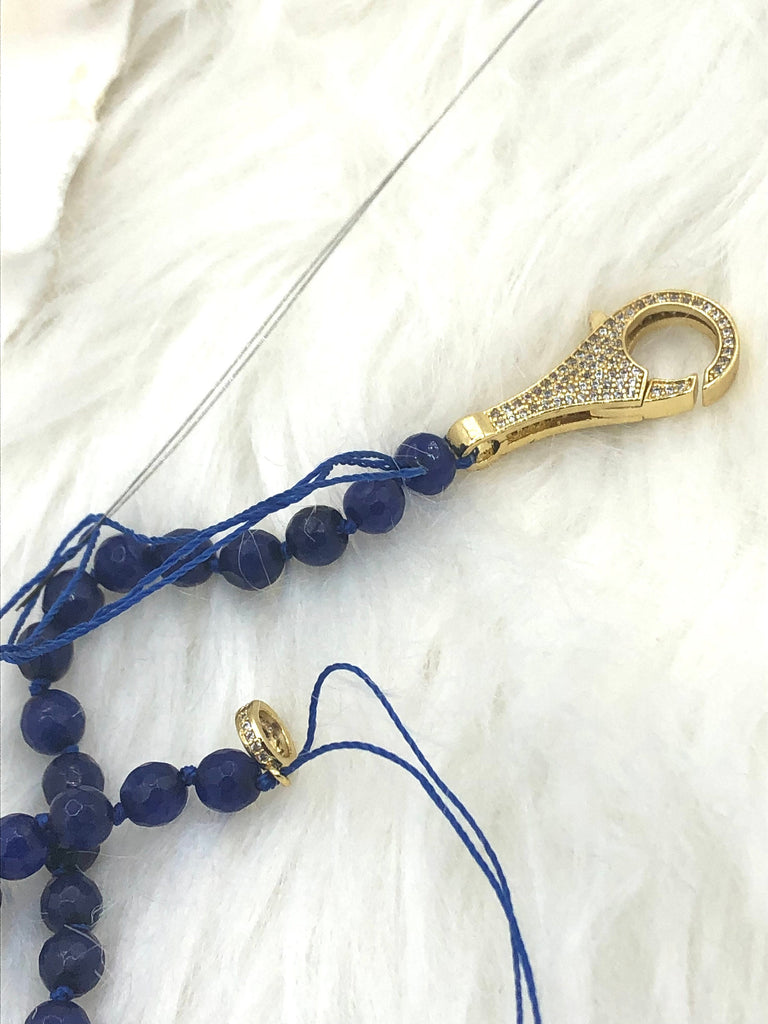
Lobster clasps are available in many sizes and silhouettes, including traditional compact claws, long claw styles, parrot claw shapes, and decorative pavé versions. BlingByA currently carries brass lobster clasp styles in multiple sizes and finishes, including small 16 mm designs and larger long-claw options. Choose the size according to the chain and the wearer’s ability to operate the lever.
Best for: everyday necklaces, delicate to medium chains, bracelets with accessible receiving rings, and jewelry that needs a familiar secure closure.
Spring Gate Clasps
Spring gate clasps open through a spring-loaded gate, push section, or button-like mechanism. Many are round, oval, heart-shaped, horseshoe-shaped, or sculptural. Because the opening can accept charms, pendants, and chain links, these clasps are especially useful for interchangeable jewelry.
BlingByA offers easy-open spring gate styles designed for necklace building and charm holding. Some oval versions are listed in several finishes, while larger double-hook and decorative styles provide a bolder focal element. Always check the gate width and the dimensions of any charm ring that must pass through it.
Best for: front-facing necklace closures, charm holders, convertible jewelry, layered chains, and designs where the clasp is a visible focal point.
Spring gate clasps can function as closures, connectors, and removable charm holders.
Toggle Clasps
A toggle clasp consists of a bar and a ring. The bar passes through the ring and rests across it once the jewelry is closed. Toggle clasps are often easy to see and grasp, which can make them convenient for bracelets and statement necklaces.
Correct proportion is essential. The bar must be sufficiently longer than the ring opening to resist slipping back through. The design also needs enough weight or gentle tension to keep the bar seated. Very lightweight or loose jewelry may not maintain this tension reliably.
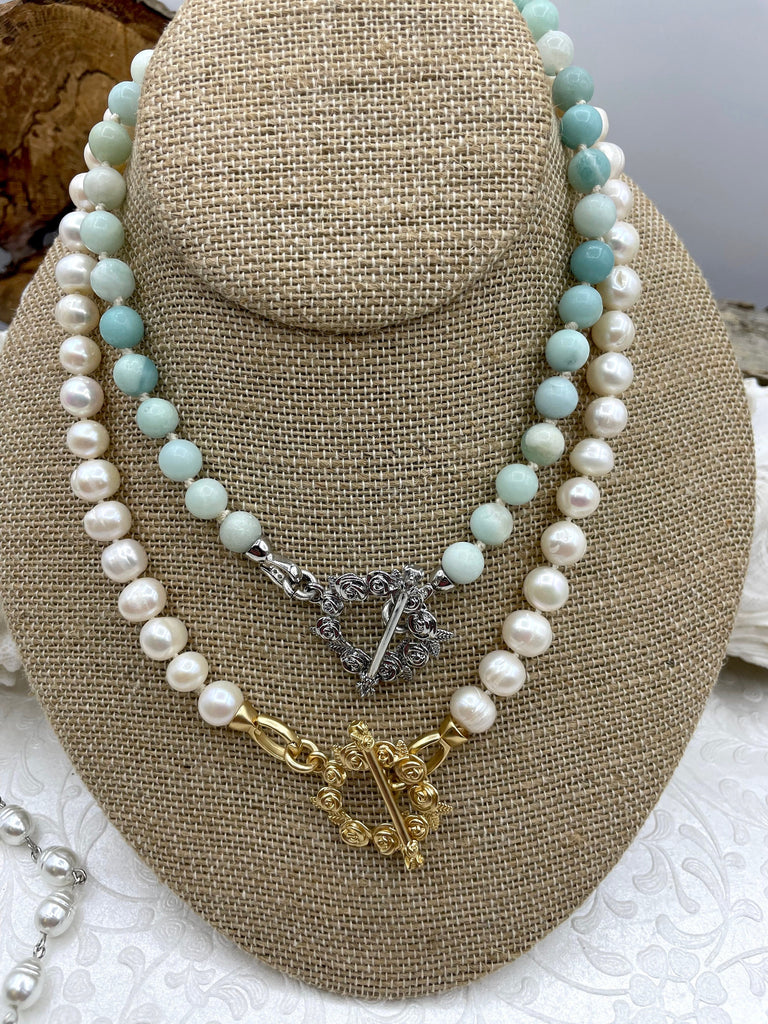
Decorative toggle clasps may include textures, CZ details, geometric rings, or sculptural bars. They can be positioned at the front of a necklace or incorporated into the bracelet design.
Best for: bracelets, statement necklaces, medium and chunky chains, decorative front closures, and designs that benefit from a clearly visible mechanism.
A toggle clasp closes when its bar passes through the ring and rests securely across the opening.
Carabiner Clasps
Carabiner clasps are inspired by utility connectors and often use a hinged or spring-loaded gate. Their bold, contemporary appearance pairs naturally with paperclip chain, chunky links, mixed-metal designs, and removable charms.
Some carabiner jewelry clasps are oval, rectangular, round, or U-shaped. BlingByA lists U-shaped lobster and carabiner styles in multiple sizes and finishes. Because these closures are prominent, consider their surface texture, proportions, and orientation as carefully as you would choose a pendant.
Best for: modern necklaces, chunky chain jewelry, charm holders, mixed-metal designs, and front-facing closures.
Screw Clasps and Screw Connectors
Screw clasps use a threaded section that twists open and closed. They may be cylindrical, oval, rectangular, or incorporated into a U-lock or carabiner shape. A screw closure can create a clean continuous appearance or an industrial focal point.
The threads must align correctly. Avoid forcing or cross-threading the closure, and tighten it fully without applying excessive pressure. Because screw clasps require several turns, they may take longer to operate than spring-loaded styles.
Best for: statement chains, unisex jewelry, industrial designs, U-lock styles, and pieces where the clasp is opened less frequently.
U-Lock, Horseshoe, and Shackle Clasps
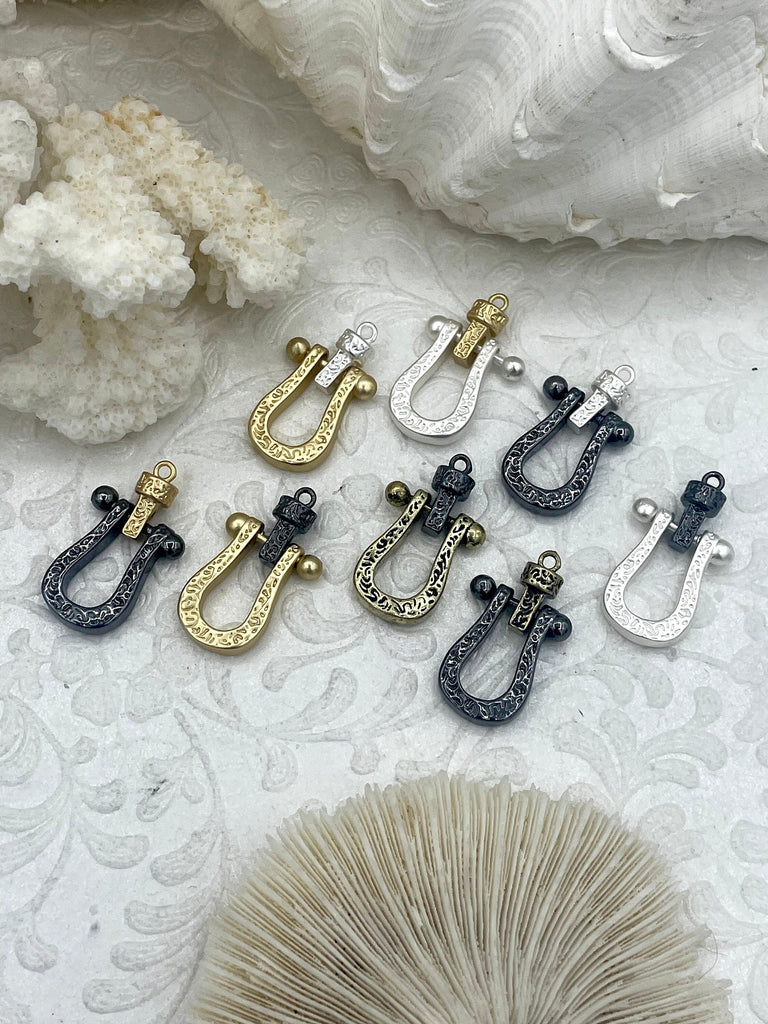
U-lock, horseshoe, marine shackle, and anchor-inspired clasps use a U-shaped body with a screw, pin, gate, or removable bar. BlingByA’s assortment includes U-shaped lobster clasps, U carabiner clasps, spring styles, and brass shackle options.
These jewelry clasps create a strong visual statement and work especially well with large chain links. The fastening pin or screw should be checked each time the piece is worn. Make sure removable parts cannot be lost during assembly or opening.
Best for: chunky necklaces, bracelets, paperclip chain, marine-inspired jewelry, and bold contemporary designs.
U-lock and shackle clasps add an industrial focal point to chunky chain designs.
Snap Circle Clasps
Snap circle clasps use a round body with a gate, latch, or snap mechanism. They provide the look of a continuous circle while allowing the designer to connect chain, charms, or pendants. Some designs resemble spring rings, while others are heavier decorative connectors.
Confirm that the moving section closes flush and that the intended components fit through the opening. Round closures can rotate naturally in a necklace, so think about whether every side is suitable for display.
Best for: front-facing closures, charm necklaces, round focal elements, and convertible jewelry.
Figure-Eight and Infinity Clasps
Figure-eight or infinity clasps may have one or two openings and can act as easy connectors between chain sections. BlingByA lists a double-opening infinity figure-eight clasp described as a spring-hook lobster style. This type of jewelry clasp can introduce symmetry and make two-component attachment easier.
Check whether one or both sections open, and determine how each side will connect to the design. The clasp should remain correctly oriented rather than twisting the chain.
Best for: two-sided connections, layered chain sections, decorative centerpieces, and jewelry with an infinity motif.
Fold-Over Clasps
Fold-over clasps use a hinged section that folds over a bar or catch and snaps into position. They are common in bracelets, watch-style bands, flat chain, and some vintage-inspired jewelry. Their broad surface can create a smooth, low-profile finish.
The clasp must align precisely with the band or chain ends. Test the hinge and catch repeatedly, and ensure the closure does not pinch the wearer or catch on clothing.
Best for: bracelets, flat chains, watch-style designs, vintage-inspired pieces, and jewelry that needs a low-profile closure.
End-Cap Clasps
An end-cap clasp combines a finishing component with a closure. The cap may be glued, crimped, folded, or mechanically attached to cord, leather, chain, or multiple strands. The opposite side connects through a hook, magnet, snap, or other mechanism.
The inner dimensions of the end cap must match the material. A loose cap may depend on too much adhesive, while a tight one can damage the cord or prevent full insertion.
Best for: leather jewelry, cord necklaces, multi-strand designs, ribbon, woven components, and pieces requiring a clean finished end.
Magnetic Clasps
Magnetic clasps use opposing magnets to close. They can be easy to operate, particularly on bracelets, but their holding power must suit the jewelry’s weight and expected movement. They are not appropriate for every wearer or situation, and users with implanted medical devices should follow guidance from their medical professional regarding magnets.
Best for: lightweight to medium jewelry, easy-access closures, and designs where the magnetic strength has been carefully tested.
Which Clasps Are Best for Necklaces?
The best necklace clasps depend on chain weight, neckline position, pendant size, and whether the closure should be visible.
Necklace Style
Recommended Clasps
Why They Work
Delicate chain necklace
Small lobster clasp, compact spring clasp
Lightweight and visually proportionate
Medium pendant necklace
Lobster clasp, spring gate clasp
Reliable support with several design options
Chunky paperclip chain
Carabiner, U-lock, shackle, large spring gate
Bold scale complements larger links
Charm necklace
Front spring gate, snap circle, carabiner
Allows removable and interchangeable charms
Statement necklace
Toggle, shackle, decorative screw clasp
Closure can become part of the focal design
Multi-strand necklace
Large lobster, toggle, end-cap clasp
Supports organized strand connections
For a back closure, a lobster clasp is often a practical choice. For a front closure, decorative spring gate, toggle, carabiner, or shackle styles can become part of the composition. When the necklace carries a valuable or heavy pendant, prioritize strength and secure assembly over visual delicacy.
Which Clasps Are Best for Bracelets?
Bracelet clasps must often be fastened with one hand, so usability becomes especially important. A large lobster clasp may be easier than a tiny one. Toggle clasps are highly visible and can be simple to guide through the receiving ring. Fold-over clasps can create a smooth profile, while magnetic closures may be convenient when their strength is appropriate.
Bracelets also experience repeated bending and contact with surfaces. The clasp should not have sharp corners or protruding components that catch on sleeves. Test the bracelet by flexing it, rotating the clasp around the wrist, and gently pulling in several directions.
Bracelet design note: Measure the finished length with the clasp closed. Large clasps and toggles add usable length and can make a bracelet fit differently than expected.
Decorative Clasps vs. Hidden Clasps
Hidden jewelry clasps are selected mainly for function and are usually positioned behind the neck or on the underside of the wrist. They should be neat, secure, and visually quiet. Small lobster clasps and discreet spring closures are common choices.
Decorative clasps are meant to be noticed. Spring gate clasps, carabiners, toggles, pavé lobster claws, infinity connectors, and shackle clasps may sit at the front of a necklace beside charms or pendants. They can add texture, contrast, movement, and a contemporary hardware-inspired look.
Neither approach is universally better. Choose according to the design’s focal point. If the pendant is elaborate, a quiet back clasp may preserve visual focus. If the chain is simple, a bold clasp can provide the missing statement.
How to Choose the Correct Jewelry Clasp Size
Clasp size should be based on scale, strength, operation, and compatibility. There is no single size that works for every design.
Match the Clasp to the Chain
Compare the clasp body with the chain link width and thickness. A clasp that is much smaller than the chain may appear weak or be difficult to connect. A clasp that is much larger can dominate a delicate necklace unless it is intentionally used as a focal point.
Measure the Gate Opening
The opening must fit over the receiving ring or link. This is especially important for carabiners, spring gate clasps, and lobster clasps. A large outer dimension does not guarantee a wide usable opening.
Check Attachment Loops
The clasp’s attachment loop must accept the jump ring, wire, chain, or connector being used. Avoid forcing a thick ring through a delicate loop, which may distort or scratch the clasp.
Consider the Wearer
Larger clasps are often easier to see and operate. For bracelets, test whether the wearer can reach the lever, guide a toggle bar, or tighten a screw with one hand.
Matching Clasps with Jewelry Chains
The clasp should complement both the engineering and the visual character of the chain. Review the chain’s link size, flexibility, finish, and overall weight before selecting the closure.
Fine and Delicate Chains
Small lobster clasps and compact spring closures normally provide the best balance. Use fine but adequately strong jump rings, and make sure the receiving ring is easy enough to locate.
Paperclip and Large-Link Chains
Paperclip chains naturally pair with carabiners, U-locks, shackle clasps, and spring gate closures. These clasps can connect directly to a suitable link or through a jump ring. Their geometric shapes reinforce the contemporary character of the chain.
Rolo and Cable Chains
Rolo chain and cable chain are versatile and work with lobster clasps, toggles, spring gates, and decorative front closures. Select a clasp whose attachment loop and receiving component fit the chain links without crowding them.
Pearl, Rosary, and Hand-Knotted Chains
Pearl and rosary-style chains often benefit from a refined lobster clasp, decorative toggle, or spring gate clasp that coordinates with the wire and bead finish. For hand-knotted necklace chains, confirm how the end loops are finished and whether an additional connector is required.
Mixed-Metal Chains
A clasp can help unify a mixed-metal design. Choose one of the repeated finishes or use a two-tone closure when available. The contrast should look intentional rather than accidental.
Explore Jewelry Clasps and Findings
Find decorative and functional closures to coordinate with chains, pendants, and charms.
Pendants affect the required strength and visual balance of a necklace. A large or heavy focal piece generally needs a stronger chain, clasp, and connection system. A small pendant or delicate charm can pair with a compact closure.
Front-facing spring gate and carabiner clasps are particularly useful for removable charms. Before assembly, confirm that each charm ring, bail, or pendant loop fits through the gate opening. For coin pendants, consider whether the clasp should visually echo the coin’s finish and scale or remain hidden at the back.
Avoid attaching a heavy pendant to a decorative clasp unless the mechanism and connections are suitable for the load. The clasp may look substantial but still have a small gate, thin attachment loop, or delicate pavé surface.
A front-facing clasp can connect the chain while displaying removable pendants and charms.
Choosing Clasp Materials and Finishes
BlingByA’s clasp and findings assortment includes products described as brass, base metal, and zinc alloy, along with a range of electroplated finishes. Product pages may list gold, silver or rhodium tones, gunmetal, matte gold, matte silver, worn gold, worn silver, matte gunmetal, and matte black.
Match the clasp finish with the chain, jump rings, connectors, and pendant whenever you want a unified appearance. Slight variations can occur between materials and production batches, so compare components in the same lighting before final assembly.
Mixed-metal jewelry can intentionally combine gold, silver, gunmetal, or worn finishes. Repeat each tone in more than one place so the contrast feels planned. When selling finished jewelry, describe the materials and plating accurately according to supplier information rather than relying on color alone.
How to Attach and Test a Jewelry Clasp
Use the Correct Jump Rings
Select jump rings that fit the clasp loop and chain while providing adequate wire thickness. Open rings by twisting the ends sideways with two pairs of pliers. Do not pull them apart from front to back, because that distorts the circular shape.
Protect the Finish
Use smooth-jaw or nylon-jaw pliers when possible. Decorative surfaces, plating, pavé details, and polished metal can be marked by serrated tools or excessive pressure.
Check Orientation
Before closing the final jump ring, make sure the clasp faces the intended direction. Toggle bars, decorative gates, and U-lock screws can sit awkwardly if the chain is attached to the wrong side.
Perform a Function Test
Open and close the clasp repeatedly. Confirm that the gate returns fully, the toggle seats correctly, the screw threads smoothly, the fold-over catch locks, or the pin remains secure. Gently pull the finished jewelry from several angles and inspect all seams and rings.
Common Jewelry Clasp Mistakes to Avoid
Choosing by appearance alone: A clasp must suit the weight, openings, movement, and intended wearer.
Using a clasp that is too small: It may be difficult to operate or look weak beside a large chain.
Using a clasp that is too large: It can pull a delicate necklace backward or overpower the pendant.
Ignoring the gate opening: The outer size may look correct even when the usable opening is too narrow.
Using weak jump rings: The clasp can be strong while the connecting ring becomes the failure point.
Installing a toggle without enough bar length: The bar may slip through the ring under slack conditions.
Cross-threading a screw clasp: Forced threads can damage the mechanism and prevent secure closure.
Placing a decorative clasp backward: Check the display side and attachment orientation before closing rings.
Mixing finishes unintentionally: Compare the clasp, chain, rings, and pendant under the same light.
Skipping a wear test: A clasp may behave differently once the jewelry moves on the body.
Jewelry Clasp Care and Maintenance
Keep clasps clean and dry according to the care requirements of the specific material and finish. Wipe components gently with a soft, nonabrasive cloth after wear. Avoid harsh chemicals, abrasive polishing, and prolonged moisture unless the supplier confirms that the product can tolerate them.
Inspect spring mechanisms, gates, pins, screws, jump rings, and receiving loops regularly. If a closure no longer closes fully, feels unusually loose, or shows visible damage, replace it before wearing the jewelry again.
Store finished pieces so heavy chains do not rub against polished or plated clasps. Close screw and toggle components before storage when doing so prevents loose parts from becoming lost.
Frequently Asked Questions About Jewelry Clasps
What is the most secure type of jewelry clasp?
Security depends on the clasp’s construction, size, material, connection method, and the weight of the jewelry. Properly sized lobster, screw, shackle, and spring gate clasps can all be secure when assembled and tested correctly.
What is the best clasp for a necklace?
A lobster clasp is a versatile choice for many necklaces. Decorative spring gates, toggles, carabiners, and shackle clasps are excellent when the closure should be visible or hold charms.
What is the easiest bracelet clasp to use?
Many wearers find larger toggles, lobster clasps, or magnetic closures easier than very small spring clasps. The best option depends on dexterity, jewelry weight, and the desired level of security.
Are toggle clasps secure?
Toggle clasps can be secure when the bar is long enough, the receiving ring is correctly sized, and the jewelry maintains enough weight or tension to keep the bar seated.
Can spring gate clasps hold charms?
Yes. Many decorative spring gate clasps are designed to act as closures and charm holders. Check the gate opening against the charm’s ring or bail.
What is the difference between a lobster clasp and a carabiner clasp?
Lobster clasps usually have a curved claw operated by a lever. Carabiner clasps often have a larger geometric body and gate, creating a bolder utility-inspired appearance.
How do I choose the correct clasp size?
Match the clasp to the chain’s scale and weight, confirm the gate and attachment-loop dimensions, and consider how easily the wearer can operate the mechanism.
Can I use a large clasp on a delicate chain?
You can when the oversized clasp is an intentional focal point and the chain connections are strong enough. Otherwise, a very large closure may look unbalanced or pull the necklace backward.
Why does my necklace clasp move to the front?
A heavy clasp, lightweight chain, off-center pendant, or normal body movement may cause rotation. A lighter closure, balanced pendant, suitable extender, or more symmetrical design may help.
Should the clasp match the chain color exactly?
Exact matching creates a unified look, but slight finish differences can occur. Mixed metals are also effective when the contrast is intentional and repeated throughout the design.
What clasp works best with chunky paperclip chain?
Large spring gate clasps, carabiners, U-locks, shackle clasps, screw clasps, and decorative toggles generally complement chunky paperclip links.
How do I attach a clasp to chain?
Most clasps attach with a properly sized jump ring or connector. Open the ring sideways with two pliers, add the clasp and chain, then twist it closed until the ends align.
Why will my screw clasp not close smoothly?
The threads may be misaligned, dirty, damaged, or cross-threaded. Stop if resistance feels unusual, realign the parts, and do not force the mechanism.
Can a clasp be used as the focal point of a necklace?
Yes. Decorative spring gates, toggles, pavé clasps, carabiners, infinity clasps, and shackle styles are often positioned at the front as part of the design.
How often should jewelry clasps be inspected?
Inspect them whenever you clean the jewelry and before wearing valuable or heavy pieces. Look for gaps, weak springs, loose pins, damaged threads, and worn connecting rings.
Conclusion
Choosing the right clasp is an essential part of professional jewelry design. The best closure must support the jewelry’s weight, connect to the available rings or links, remain comfortable for the wearer, and complement the overall style. Lobster clasps offer familiar versatility, spring gate clasps provide decorative flexibility, toggle clasps create visible elegance, and carabiner, screw, U-lock, and shackle clasps bring a bold contemporary look.
Before completing a necklace or bracelet, compare the clasp size with the chain, measure every opening, match the finish, and test the mechanism repeatedly. When the functional and visual details work together, the clasp becomes more than hardware—it becomes a carefully considered part of the finished jewelry.
Find the Right Clasp for Your Next Jewelry Design
Explore BlingByA clasps and findings in a variety of styles, sizes, materials, and finishes.